
MODERN REVENUE CAN’T RUN ON STATIC SYSTEMS ANY LONGER.
Most revenue systems were designed for simpler buying environments — linear journeys, centralized demand, and predictable execution flows.
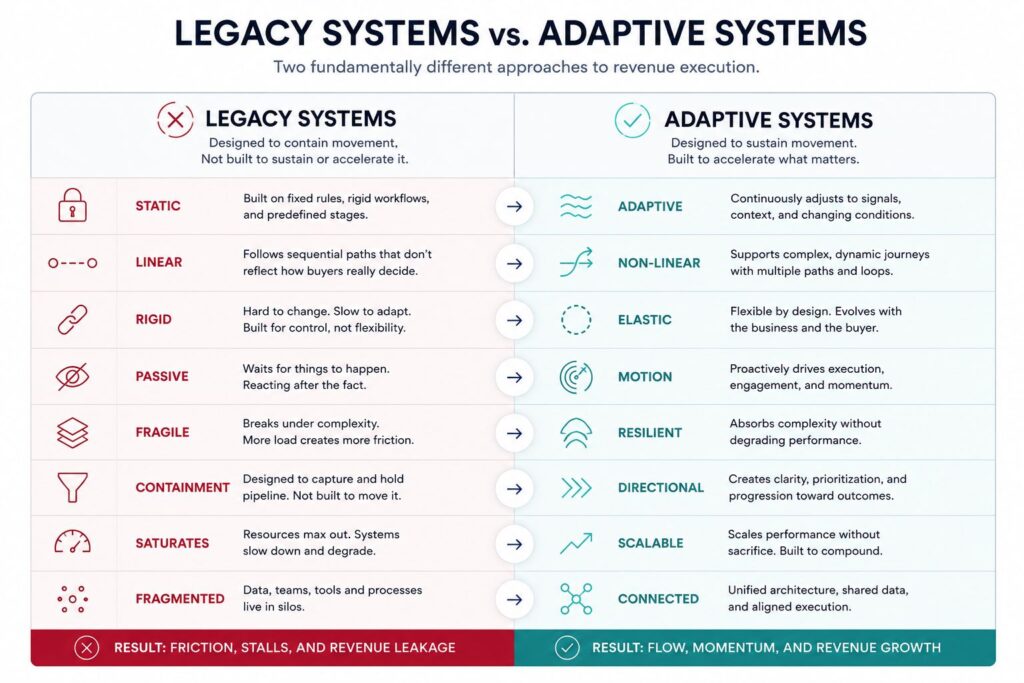
Modern revenue environments operate differently: fragmented demand, multi-stakeholder decisions, real-time expectations, and constant operational pressure. Static systems built struggle to sustain pipeline progression under complexity.
Static
Traditional funnels were built to contain pipeline activity inside predefined stages — not to sustain adaptive opportunity progression across dynamic buying journeys.
Linear
Legacy systems assume revenue progression follows predictable, sequential flows. Modern journeys move non-linearly across channels, stakeholders, and decision cycles.
Rigid
As demand volume and operational complexity increases, rigid workflows create coordination friction, execution gaps, and stalled pipeline momentum across teams and channels.
Passive
Most systems capture information after activity happens. They lack the execution intelligence required to coordinate, prioritize, and sustain revenue motion in real time.
Accidental Architecture
Revenue Leaks Are Architectural
Most growth problems aren’t caused by lack of demand, but by missing execution between demand signals, opportunities, and revenue.
Find where demand fails to become revenue.
Explore the System
Explore the structural dynamics reshaping buying decisions — and the adaptive systems designed to keep revenue in motion at scale.
1. Why is pipeline progression becoming harder?
Modern buying environments have become increasingly fragmented, saturated, and difficult to coordinate — making sustained pipeline progression harder to maintain across the revenue lifecycle.
2. Where does revenue momentum break?
Execution gaps, disconnected workflows, and inconsistent follow-up create hidden leakage points that silently reduce velocity, weaken conversion, and slow revenue progression.
3. Why do modern revenue systems struggle under complexity?
Most legacy revenue systems were designed for linear buyer journeys and predictable execution environments — not adaptive, multi-threaded commercial operations.
4. How does adaptive revenue execution become possible?
Pipeline Circuits operate on top of an adaptive progression infrastructure designed to coordinate execution, sustain operational resilience, and scale revenue motion under pressure.
5. What changes when revenue operates in motion?
Adaptive revenue systems create new structural capabilities across visibility, orchestration, intelligence, and scalable execution continuity.
6. How would your pipeline operate under adaptive execution?
Design a progression system tailored to your revenue environment, pipeline complexity, operational structure, and commercial growth dynamics.
Explore Perspective →
Modern revenue environments won’t become simpler.
Adaptive execution systems will become essential.

QUIT FRICTION. KEEP MOTION
Nubexa combines data, AI, and automation to structure, execute, and optimize your entire revenue engine—from demand generation to sales execution.