
REVENUE MOMENTUM BREAKS THROUGH EXECUTION GAPS.
As operational complexity increases, revenue progression becomes increasingly fragile.
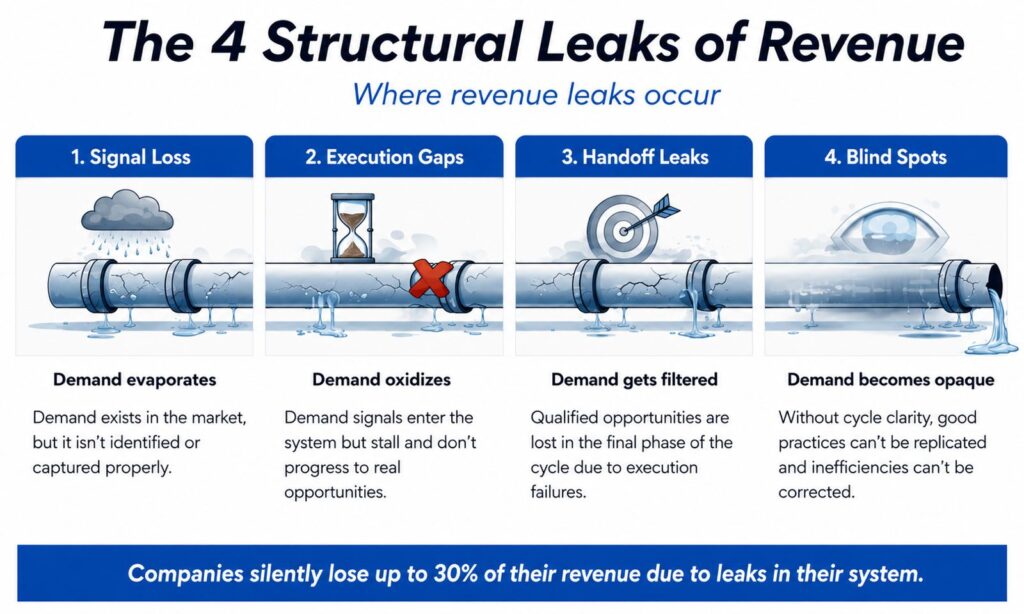
Signals lose momentum, execution slows, handoffs break down, and visibility weakens across the pipeline — creating silent leakage that reduces sales velocity, acquisition efficiency, and revenue yield before teams even detect the impact.
Signal Loss
Buying intent enters through disconnected channels, weak capture flows, and low-visibility touchpoints. Valuable opportunities lose momentum before engagement begins.
Execution Gaps
Opportunities stall when follow-up slows, ownership becomes unclear, and execution loses continuity. Pipeline pressure exposes coordination gaps and operational bottlenecks.
Handoff Leaks
As opportunities move across teams and stages through the pipeline, fragmented transitions create delays, weak accountability, and lost momentum before deals convert into revenue.
Blind Spots
Disconnected execution and weak attribution reduce visibility across pipeline activity and revenue performance. Teams lose clarity as operational complexity increases.
Accidental Architecture
Revenue Leaks Are Architectural
Most growth problems aren’t caused by lack of demand, but by missing execution between demand signals, opportunities, and revenue.
Find where demand fails to become revenue.
Explore the System
Explore the structural dynamics reshaping buying decisions — and the adaptive systems designed to keep revenue in motion at scale.
1. Why is pipeline progression becoming harder?
Modern buying environments have become increasingly fragmented, saturated, and difficult to coordinate — making sustained pipeline progression harder to maintain across the revenue lifecycle.
2. Where does revenue momentum break?
Execution gaps, disconnected workflows, and inconsistent follow-up create hidden leakage points that silently reduce velocity, weaken conversion, and slow revenue progression.
3. Why do modern revenue systems struggle under complexity?
Most legacy revenue systems were designed for linear buyer journeys and predictable execution environments — not adaptive, multi-threaded commercial operations.
4. How does adaptive revenue execution become possible?
Pipeline Circuits operate on top of an adaptive progression infrastructure designed to coordinate execution, sustain operational resilience, and scale revenue motion under pressure.
5. What changes when revenue operates in motion?
Adaptive revenue systems create new structural capabilities across visibility, orchestration, intelligence, and scalable execution continuity.
6. How would your pipeline operate under adaptive execution?
Design a progression system tailored to your revenue environment, pipeline complexity, operational structure, and commercial growth dynamics.
Explore Perspective →
Modern revenue environments won’t become simpler.
Adaptive execution systems will become essential.

QUIT FRICTION. KEEP MOTION
Nubexa combines data, AI, and automation to structure, execute, and optimize your entire revenue engine—from demand generation to sales execution.